
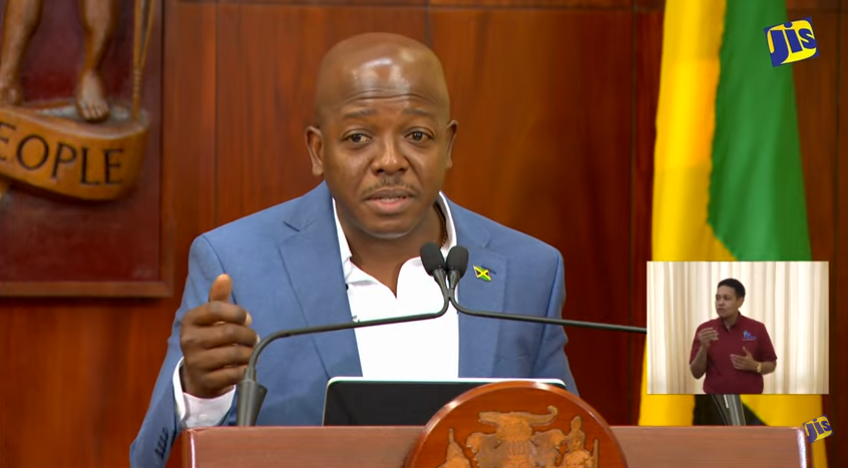
Minister of Labour and Social Security, Pearnel Charles Jr, says the government’s Restoration of Owner and Occupant Family Shelters (ROOFS) programme is designed strictly to assist Jamaicans in repairing the homes where they live, not businesses or rental properties.
Minister Charles Jr said the programme is aimed at restoring family shelters damaged by Hurricane Melissa and is part of the wider Shelter Recovery Programme (SRP).
“This programme is focused on the residence where you live,” Charles explained. “So many persons ask about their farm that has been destroyed, or their business, or their shop. This programme is not the programme to fix those issues.”
Speaking at Wednesday’s post-Cabinet media briefing, the minister outlined that the initiative specifically targets owner-occupiers and families living in affected homes, even if the occupants are not the legal owners.
He noted that some people may own multiple houses in the same area that were damaged during the storm, but only their primary residence qualifies for assistance.
“Anywhere else we consider commercial,” Charles said. “So if you are renting a property, that’s a different matter. That’s a business matter. This is for the residence that is your family shelter.”
$10 billion allocation for roof repairs
The ROOFS programme is the flagship component of the SRP, which contains six elements aimed at supporting recovery efforts after the hurricane.
Charles said the initiative carries a $10-billion allocation to provide cash grants to eligible households to help restore damaged roofs.
The process begins with household assessments conducted by hundreds of volunteers and field officers from several ministries, including the Ministry of Labour and Social Security. These teams gather information on the damage sustained by homes.
“We had hundreds of persons out on the ground doing the household assessments,” he said, noting that the team included trained personnel coordinated by the ministry’s technical staff.
Over 100,000 assessments completed
Charles revealed that more than 100,000 assessments have been completed so far.
He compared the pace to the response following Hurricane Beryl, when fewer than 19,000 assessments were completed over eight to nine months.
“For Melissa, with the upgraded process and electronic gathering tools, we have completed 100,000 assessments in four months,” he said, thanking field workers for their efforts.
Technology used to prevent duplication
Once assessments are completed, the data undergoes a verification process to ensure accuracy and eliminate duplicate claims.
The information is analysed by the National Spatial Data Management Branch, which uses GPS coordinates attached to each assessment to confirm the exact location of properties.
Charles explained that duplication can occur if multiple members of a household are assessed separately or if someone attempts to claim assistance for multiple properties.
“It is one benefit per household,” he emphasised.
The new digital system also allows officers to upload photographs and data in real time, reducing errors that previously occurred when paper forms were used.
Beneficiaries notified by text message
Once verification is complete, successful applicants receive notification by text message containing a QR code that can be used to redeem building materials from approved suppliers.
The message includes the amount approved, details of the grant and the locations where materials can be collected.
Charles urged recipients not to delete the message, noting that the QR code is required to access the assistance.
“I’m asking you, please do not delete the text message,” he said.
The minister also advised residents who have already been assessed not to request another assessment, warning that doing so could cause delays in processing their claims.