
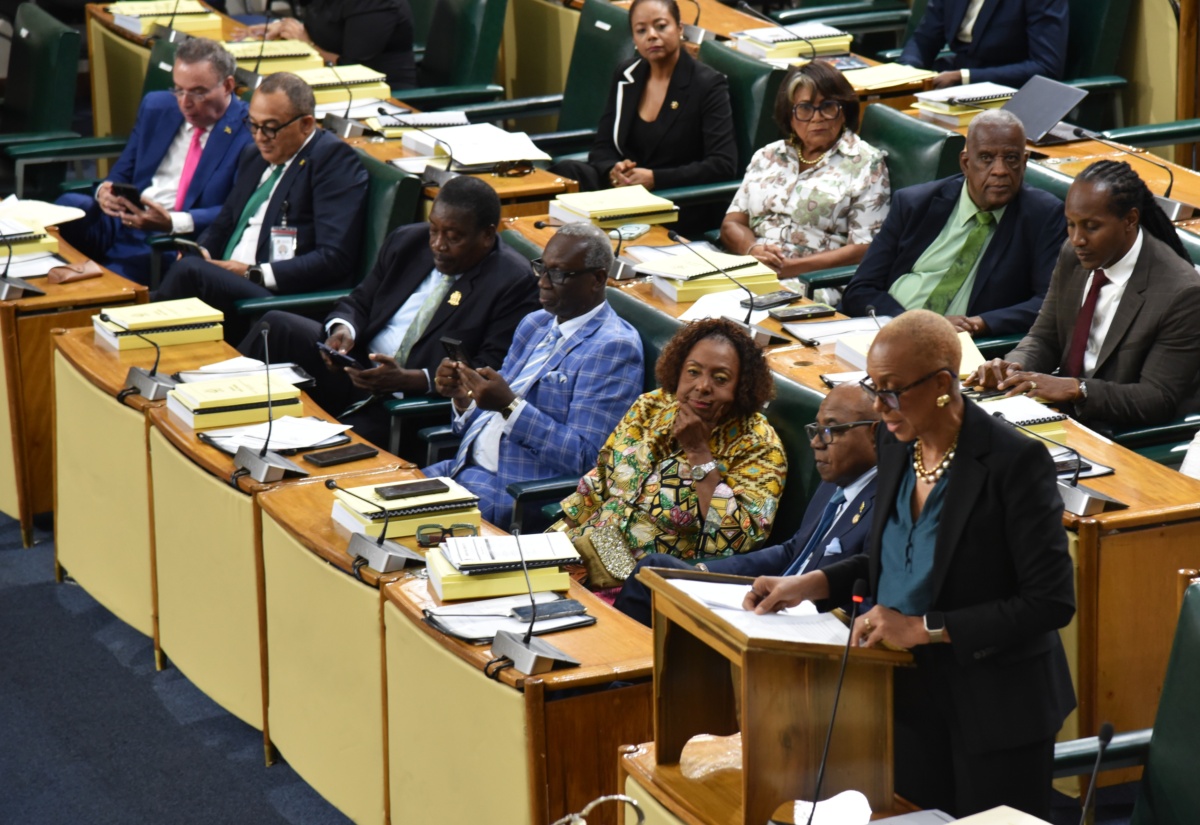
Minister of Finance and the Public Service, Hon. Fayval Williams, on Thursday (February 12) tabled new revenue measures for implementation in fiscal years 2026/27 and 2027/28.
The Government is projected to earn approximately $29.439 billion in fiscal year 2026/27 from these measures.
Mrs. Williams explained that the Independent Fiscal Commissioner raised concerns that successive governments have failed to table revenue measures alongside the budget documents, despite this being a requirement under the Financial Administration and Audit (FAA) Act.
“In the interest of full disclosure and, more importantly, in compliance with our very own law that was passed in this Parliament, and to enable the Independent Fiscal Commissioner to have full visibility into the budget figures in order to do the assessment as to whether the budget is credible or not, we are laying the revenue measures today as well,” she stated.
The Minister was speaking as she tabled the 2026/27 Estimates of Expenditure in the House of Representatives.
“This Government has had the longest number of years of no new taxes in the history of independent Jamaica. Only a Category 5 hurricane with winds of 185 miles per hour could have interrupted that,” Mrs. Williams said.
The Minister explained that the hurricane caused unprecedented damage to critical infrastructure, productive sectors and public assets, placing severe pressure on public finances and reconstruction expenditure, which is expected to extend across the medium term.
“Against this background, expenditure containment and administrative improvements cannot close the emerging fiscal gap. It is therefore imperative that targeted revenue measures to strengthen revenue performance, safeguard fiscal sustainability and ensure the Government’s continued ability to deliver essential public services are introduced,” she further stated.
The proposed fiscal revenue measures are designed to address areas that remain undertaxed, such as digital services.
In keeping with Jamaica’s commitment to environmental preservation, the Government is also proposing an increase in environmental protection levy revenues to support recovery efforts. Additionally, the package introduces a tax on sweetened beverages, which are widely regarded as detrimental to healthy living.
Mrs. Williams explained that applying General Consumption Tax (GCT) to digital services and intangibles supplied from abroad reflects ongoing efforts to modernise the tax system and promote fairness within the digital economy.
She noted that digital services now account for a growing share of consumption among Jamaican households and businesses.
“Many of these services are supplied by non-resident providers with no physical presence in Jamaica, resulting in inconsistent application of GCT on the existing arrangement. The rapid growth in digital transactions has highlighted gaps in the current tax framework. Similarly, services may be subject to different tax treatments, depending on whether they are applied locally or from overseas, placing our domestic businesses at a competitive disadvantage,” the Minister stated.
Additionally, she noted that the growing shift toward untaxed digital consumption contributes to revenue leakage and constrains the Government’s capacity to finance public services.
“The proposed reform is guided by the destination principle, an internationally accepted standard for consumption taxation. Under this principle, GCT applies where a service is consumed rather than where the supplier is located. In practical terms, this means that digital services consumed in Jamaica should be subject to GCT in the same way as locally supplied equivalent services,” Mrs. Williams said.
She noted that the application of GCT to international digital services and intangibles is expected to yield a positive revenue impact, once fully implemented.
The measure is projected to generate approximately $300 million in the first instance, beginning in the fourth quarter of fiscal year 2026/27. Upon full implementation in the 2027/28 financial year, government revenues are expected to increase by $4.2 billion.
The Government is also proposing to introduce a levy, the Special Consumption Tax (SCT), on non‑alcoholic sweetened beverages.
“For this measure, non-alcoholic sweetened beverages are defined as all non-alcoholic beverages containing added sugar or other caloric sweeteners, as well as beverages containing artificial or non-nutritive sweeteners, whether carbonated or non-carbonated, and whether manufactured locally or imported. The primary objective of this measure is not only revenue mobilisation, but it also supports broader public health objectives,” Mrs. Williams said.
She explained that Jamaica continues to experience elevated levels of obesity and diabetes, with sweetened beverages recognised as a significant source of excess sugar consumption.
Data from the 2024 Economic and Social Survey of Jamaica indicate that domestic production of carbonated beverages rose from approximately 17.3 million cases in 2020 to an estimated 20.1 million cases in 2024, reflecting sustained demand.
Sweetened beverages are currently subject only to the standard GCT rate of 15 per cent and are not listed in the GCT Act as prescribed goods for SCT purposes.
Under the proposal, the SCT would be assessed on a per‑unit basis, calculated according to the total liquid volume of each sweetened beverage measured in millilitres.
“The SCT will apply at the point of manufacture for domestic producers and at the point of importation for imported products, in accordance with the provisions of the GCT Act. This ensures administrative efficiency and parity between local and imported goods.
The SCT will be applied at a rate of $0.02, which is two cents per millilitre,” Mrs. Williams said.
“The estimated revenue gain associated with levying the SCT on non-alcoholic sweetened beverages is estimated at $10.1 billion and will take effect during the first quarter of fiscal year 2026/27,” she added.
Regarding the increase in SCT on all alcoholic beverages, Mrs. Williams stated that the rate will be raised from $1,230 per litre of pure alcohol to $1,400.
She advised that this adjustment is intended to preserve the real value of the tax and strengthen revenue mobilisation.
“The proposed increases will apply uniformly to locally manufactured and imported alcohol beverages, ensuring neutrality of treatment and maintaining consistency within the existing SCT framework. The estimated revenue gain associated with increasing the SCT on this litre of pure alcohol is estimated at $1.6 billion, and will take effect May 1, 2026,” the Minister further indicated.
The SCT on cigarettes will also be increased by $3 per stick, moving the effective specific rate from $17 to $20.
Mrs. Williams explained that the existing specific rate was established following the March 13, 2017, adjustment, which likewise raised the tax by $3 per stick.
She indicated that the proposed increases will apply uniformly to both locally manufactured and imported cigarette products, thereby ensuring neutrality of treatment and maintaining consistency within the existing SCT framework.
The estimated revenue gain from increasing the SCT on cigarettes is approximately $1.1 billion, with the measure scheduled to take effect on May 1, 2026.
Turning to the duty concession on motor vehicles for public officials, Mrs. Williams explained that the existing 20 per cent concession for designated positions reduces the duties payable on imported or purchased vehicles.
She noted that the concession was originally introduced to lower the cost of vehicle ownership, support mobility and assist certain public sector groups—conditions that no longer prevail.
“It represents a significant reduction in government revenues. Currently, under the 20 per cent duty concession framework, public officials in eligible posts are afforded preferential tax treatment on importation of motor vehicles. Within this framework, both the SCT and the GCT are fully waived, and the applicable customs duty is 20 per cent of the vehicle’s CIF (Cost, Insurance and Freight) value. Consequently, beneficiaries of the concession are required to pay 20 per cent customs duty with no liability for SCT or GCT.
“It is proposed that the 20 per cent duty concession on motor vehicles be amended. It is proposed that the 20 per cent import duty remain payable, the GCT becomes payable and the SCT exemption remains. The estimated revenue gain associated with removal of the GCT exemption is approximately $1.3 billion, and it will be effective May 1, 2026,” the Minister added.
Regarding the increase in the environmental protection levy rate, Mrs. Williams stated that recent events have underscored the urgent need for strengthened environmental safeguards.
She added that this includes the introduction of enhanced penalties designed to deter pollution.
“In an effort to finance enhancement of climate resilience, it is proposed to increase the environmental protection levy rate to 0.8 per cent from 0.5 per cent for both imports and domestic goods, and to expand the base on which the domestic levy is charged from 75 per cent of sales to 100 per cent. It is estimated that these adjustments will result in $3.639 billion in revenues, effective May 1, 2026,” the Minister indicated.
Mrs. Williams also noted that the GCT rate on tourism activities will be increased to the standard rate of 15 per cent, up from the current 10 per cent.
“Over the years, the Government of Jamaica has provided special tax treatment to the tourism industry to alleviate the tax burden and propel the industry to a level of maturity. This support was delivered through targeted tax credits, including the special tax credit (STC) and the special alcoholic beverages credit (SABC),” she stated.
The Minister noted that these credits allowed eligible tourism entities to reduce their net tax liability based on prescribed formulas, including credits linked to non‑tourism revenue streams and to GCT paid on alcoholic beverages used in taxable activities.
“While effective in reducing the tax burden, these arrangements were administratively complex. In fiscal year 2005/06, the credit-based system was repealed and replaced with a simplified regime under which the tourism industry was subject to 50 per cent of the standard GCT rate, resulting in an effective rate of 8.25 per cent. This rate was subsequently adjusted in fiscal year 2009/10 to the current rate of 10 per cent. Since that time, the industry has continued to mature and demonstrate sustained growth in arrivals, room stock and earnings.
“In this regard, the House is asked to note that, considering the foregoing and Government’s revenue needs over the medium term, the GCT rate applicable to specified tourism activities is to be increased to 15 per cent, effective April 1, 2027. The GCT rate on tourism activities is estimated to yield $11.4 billion in additional revenues annually,” she further stated.
Meanwhile, the Finance Minister confirmed the continuation of the annual transfer of $11.4 billion from the National Housing Trust (NHT) to central government.
She explained that, given the impact of Hurricane Melissa on the island, the continuation of these transfers across the medium term is necessary to support the sustainability of fiscal operations while reconstruction activities are underway.
“It is therefore proposed that the annual transfer of $11.4 billion from the National Housing Trust to the central government be continued for another five years, from fiscal year 2026/27 to fiscal year 2030/31,” Mrs. Williams stated.